Back

LeCore Banking Platform

An event-driven retail banking platform built for financial correctness, recoverable payments, and operational control.
AngularSpring BootASP.NET CoreKafkaPostgreSQLRedisKubernetes
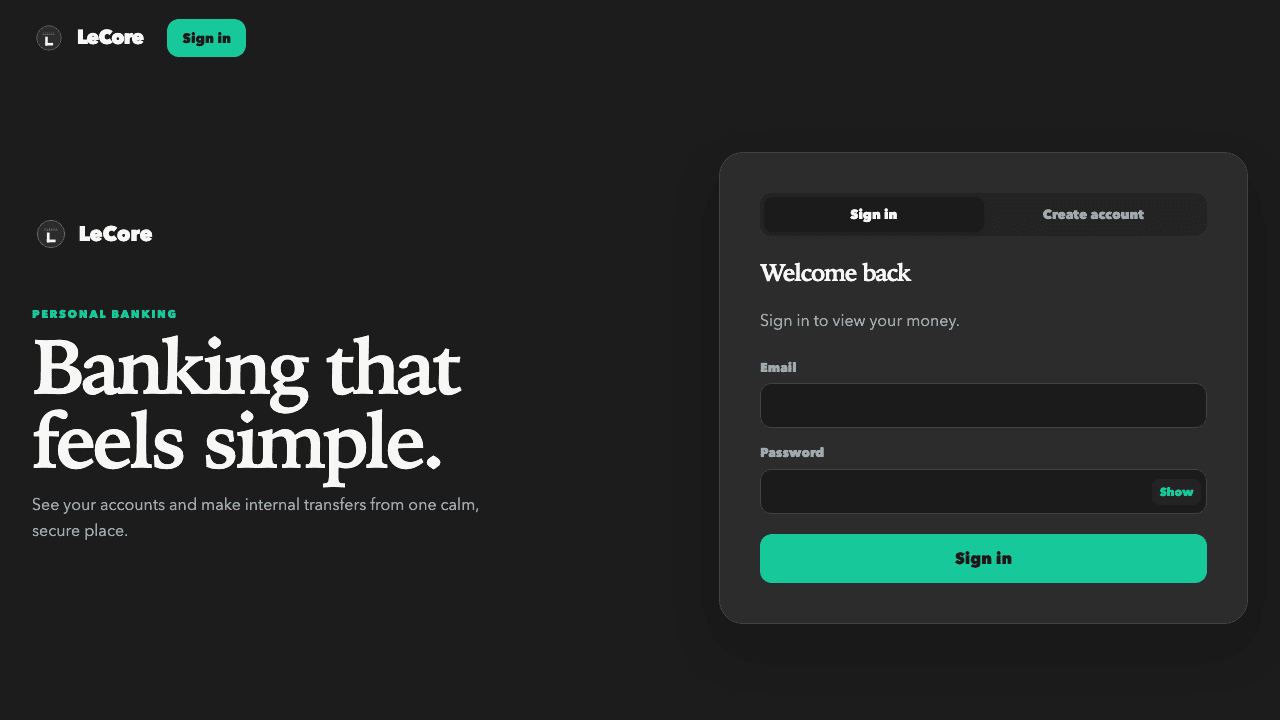
LeCore Banking Platform dashboard screenshot

9

Backend Services

2

Banking Portals

Double-entry

Ledger Model

Kubernetes

Deployment

Overview

A service-oriented banking system with separate customer and operations portals, balanced double-entry accounting, idempotent payment workflows, immutable audit history, and independent reconciliation.

The Problem

  • Prevent double spending and reject unbalanced journal entries while deriving balances from durable accounting records
  • Recover from ledger timeouts without charging a customer twice or losing a payment between services
  • Give operations teams a searchable audit trail and an independent payment-to-ledger reconciliation view
  • Keep retail users and privileged operational tooling isolated behind explicit access controls

The Solution

  • Separated identity, customer, account, payment, ledger, audit, and reconciliation into accountable service boundaries
  • Implemented idempotent payment and ledger commands with durable outbox events and deduplicating Kafka consumers
  • Built distinct Angular portals for customers and operations staff behind a single policy-enforcing API gateway
  • Created an independent ASP.NET Core reconciliation service that correlates payment events with ledger postings

Architecture Overview

High-level architecture of the application.

Key Highlights

Balanced double-entry journal posting
Idempotent, retry-safe payment workflows
Customer registration and internal transfers
KYC review and controlled account funding
Immutable audit event history
Payment-to-ledger reconciliation queues
Role-protected operations portal
Metrics, health checks, and distributed tracing

Challenges

  • Coordinating a payment lifecycle across independently deployed services without distributed database transactions
  • Handling at-least-once event delivery and out-of-order messages without duplicating financial effects
  • Distinguishing short event-delivery delays from genuine reconciliation exceptions
  • Enforcing gateway-only access and least-privilege network paths across a Kubernetes deployment

Results

  • Delivered a complete retail journey for registration, account visibility, and internal transfers
  • Made financial correctness explicit through atomic balanced postings and idempotent references
  • Equipped operations staff with customer, KYC, account, payment, audit, and reconciliation workflows
  • Established cluster-ready deployment boundaries with probes, resource limits, network policies, and observability

What I Learned

  • Financial correctness belongs in the domain model, not in infrastructure conventions
  • Independent controls need events that carry enough financial facts to verify an outcome
  • Eventual consistency needs explicit timing rules so transient delays do not become false incidents
  • Operational screens are essential product features in a distributed financial system